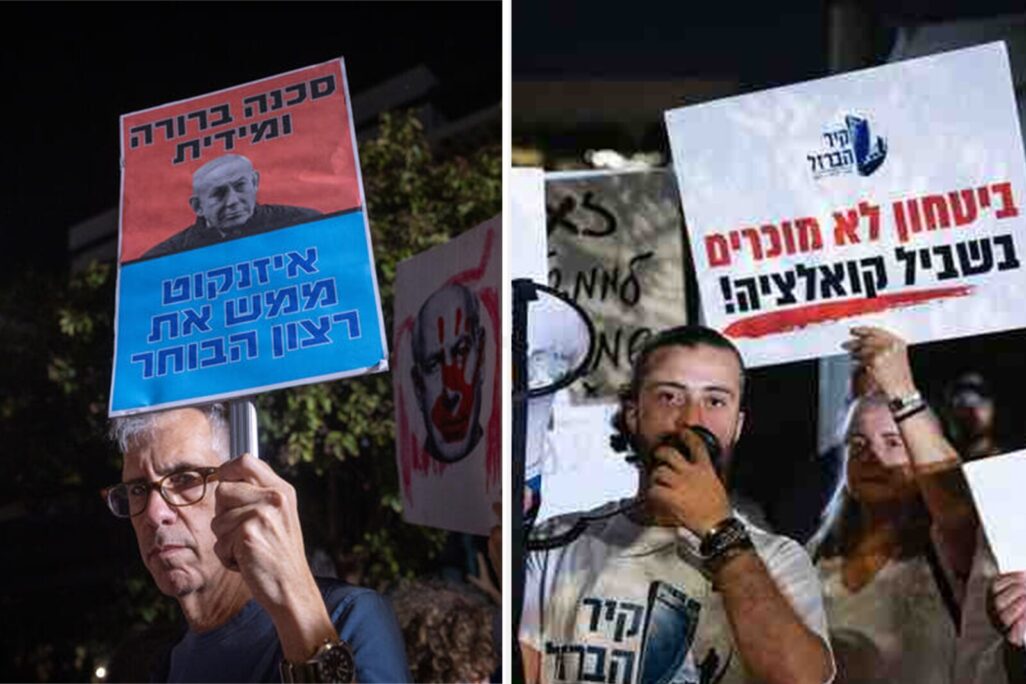



Israel’s right-wing protests are not really about whether Arab parties have political power. They are an attempt to raise the Audience Costs, and therefore the political cost, of one particular winning coalition: an Eisenkot-led government enabled by Arab votes.
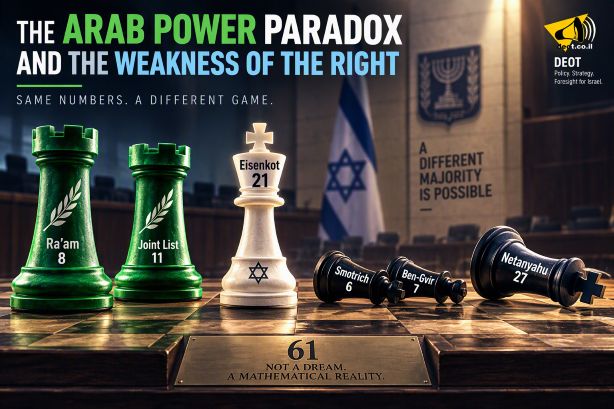
Israel’s October 27 election changed not only the distribution of seats, but the distribution of effective political power. Benjamin Netanyahu’s natural right-Haredi bloc holds only 53 seats. The Zionist opposition holds 48, while Ra’am and the Joint List hold another 19, creating a potential 67-seat anti-Netanyahu parliamentary majority.
The post-election struggle is no longer primarily about seats. It is about Audience Costs, Agenda Control and the redefinition of Veto Players. Right-wing protests seek to make the 48 + 19 = 67 coalition politically illegitimate before it becomes institutionally effective. That may explain the intensity of the protest better than ideology alone: Arab parties are being protested precisely because their parliamentary power has increased. Ben-Gvir and Smotrich, meanwhile, remain rhetorically powerful but have become structurally weaker because Netanyahu is effectively their only feasible coalition anchor.
The first votes of the new Knesset, therefore, may tell us more about who won the election than election night itself. It may present not an Arab-Zionist coalition in the traditional sense, but a parliamentary majority in which Arab representation can no longer be mathematically counted while politically ignored.
This is exactly the structural problem anticipated by Deot before the election: when neither conventional bloc controls 61 seats, political power shifts toward those actors capable of enabling or blocking alternative majorities.
Want to comment? We're waiting for you on X
Do Arabs really mean it?
This distinction is no longer merely theoretical. In a post-election statement MK Ahmad Tibi of the Joint List, Tibi drew exactly this line: “I do not want to be a minister, not at all. We will not dissolve the Knesset and will not join no-confidence motions. We will help anyone who wants to bring down this terrible government.” The statement illustrates the emerging Arab strategy particularly well: political influence without necessarily demanding cabinet membership. In other words, recommendation to the President, coalition membership, external support and legislative cooperation remain four different instruments of power. [Source: N12 interview, 31 October 2026].
Seats and Power
| Party | Seats | Banzhaf | Shapley-Shubik | Effective post-election power |
|---|---|---|---|---|
| Likud | 27 | 25.37% | 25.85% | Strong, but bloc limited to 53 |
| Yashar / Eisenkot | 21 | 17.52% | 18.70% | Strong, agenda-setting core |
| Bennett | 12 | 9.68% | 9.38% | Strong bridge |
| Joint List | 11 | 7.76% | 7.44% | Strong pivotal actor |
| Ra’am | 8 | 6.80% | 6.56% | Strong coalition / legislative bridge |
| Democrats | 8 | 6.80% | 6.56% | Medium-strong |
| Yisrael Beiteinu | 7 | 5.67% | 5.53% | Strong bridge |
| Otzma Yehudit / Ben-Gvir | 7 | 5.67% | 5.53% | Weak, Non-Blocking Player |
| UTJ | 7 | 5.67% | 5.53% | Potential bridge |
| Shas | 6 | 4.53% | 4.46% | Potential bridge |
| Religious Zionism / Smotrich | 6 | 4.53% | 4.46% | Weak, Non-Blocking Player |
The paradox lies in the difference between mathematical power and feasible political power.
Itamar Ben-Gvir and Bezalel Smotrich became accustomed to behaving as Veto Players: their threat was that without them, Benjamin Netanyahu could lose his majority.
After the election, however, even with them Netanyahu has only 53.
More importantly, neither possesses a credible alternative coalition. Their bargaining position has therefore inverted: rather than Benjamin Netanyahu being dependent on them, they are increasingly hostages to Netanyahu’s coalition strategy. In the feasible coalition game, they resemble Non-Blocking Players: they can preserve the 53-seat bloc, but cannot transform it into a majority.
The Arab parties occupy almost the opposite position. Their 19 seats can transform 48 into 67, giving them substantially greater marginal leverage over government formation and parliamentary control.
Audience Costs and Agenda Control
This explains the right-wing protests.
The demonstrations cannot alter the election result. Their strategic purpose is to alter the political cost of one particular winning coalition.
If cooperation with Arab parties becomes sufficiently costly for Gadi Eisenkot, Naftali Bennett or Avigdor Lieberman, then 67 mathematically available votes can become politically unusable. This continues a framing strategy identified before the election around delegitimising a government "dependent on Arab parties" [See here].
But the counter-strategy is Agenda Control.
Gadi Eisenkot does not necessarily need to complete coalition negotiations before demonstrating a working parliamentary majority. A majority capable of changing the Knesset Speaker, reorganising committees and passing agreed legislation can change the bargaining game before a government is formed.
And here the public debate repeatedly conflates four entirely different political acts:
Recommendation to the President ≠ coalition membership ≠ external support ≠ legislative cooperation.
This distinction is essential.
Arab parties can recommend Gadi Eisenkot, support replacing parliamentary officeholders and cooperate on legislation without necessarily joining the government. Likewise, Ra’am could negotiate formal participation while the Joint List provides selective parliamentary support.
The apparent weakness of the Arab parties may therefore be their strength, while the apparent strength of the ideological right may now conceal weakness.
Ben-Gvir and Smotrich have nowhere politically obvious to go. The Arab parties have several degrees of freedom over how, when and how much support to provide.
That asymmetry is bargaining power.