


Battle over Flags reflect deep societal rifts, and what Britain can learn from Israel before its flag becomes a tool of internal destruction enabling far right rise to fascism. As Israel’s delay deepened the divide; in Britain, early action could prevent it.
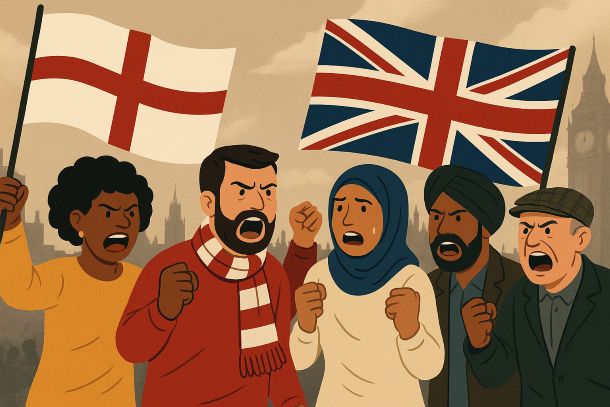
Imagine this: you’re standing in a bustling square, the national flag flying high above. Does it warm your heart as a symbol of unity, or has it been turned into a political weapon by extremists? This isn’t a fantasy - it’s the reality in Britain and Israel in 2025. In Israel, the far-right co-opted the flag, only for liberals to fight to reclaim it; in Britain, the right is seizing the St George’s Cross and Union Jack against pro-Palestinian protesters and immigrants.
This op-ed aims to expose how battles over symbols reflect deep societal rifts and what Britain can learn from Israel before its flag becomes a tool of internal destruction. An answer to a question raised on the "New Statesman" Podcast "Has the English flag been co-opted by the far-right?" with @Anoosh Chakelian and @HarryClrke.
Read, share, and join the conversation - Because silence hands victory to extremism.
co-opting the national flag
In a world where national symbols become battlegrounds for political wars, two countries - Israel and Britain - reveal strikingly similar yet distinct processes
In Israel, over the past decade, the far-right has co-opted the national flag as a symbol of Jewish nationalism, until the liberal protests of 2023 began reclaiming it for a broader, inclusive Israeli identity [1, 2]. In Britain, right now, a parallel but inverted process is underway: the right, including extremist elements, is attempting to reappropriate the English flag (St George’s Cross) and the Union Jack as weapons against pro-Palestinian protests and immigration. The question isn’t just whether there’s a parallel - there is - but whether Britain’s moderate majority can learn from Israel and act preemptively, before the flag becomes the exclusive property of narrow nationalism. More critically, this co-optation in Britain is likely to fuel the rise of fascist, racist currents that will target not just new immigrants or pro-Palestinian activists but also long-established minorities - those who have already integrated into the British nation and embraced its cultural norms.
The warning sign here isn’t just the flag’s appropriation; it’s the long-term processes that could tear British society apart from within, just as they have in Israel.
Over past decade, Israeli flag became synonymous with nationalism and far-right policies
Let’s start with the Israeli reality, familiar to many. Over the past decade, under Netanyahu’s governments, the Israeli flag became synonymous with settlements, Jewish nationalism, and far-right policies. It was most visible in Jerusalem Day marches or right-wing protests, while the centre-left shied away from it due to its connotations [1, 2]. But in 2023, with the eruption of protests against the judicial reform, the liberal movement - largely centre-left - changed the game. Protesters wielded the flag en masse, emphasising that their fight was for a shared national democracy, declaring they were “taking back” the flag from the far-right [2]. Critics on the left argued this use still excluded Palestinians and ignored the occupation, and the issue remains contentious into 2025 [3].
In short, the right’s appropriation led to alienation, and reclaiming it required immense effort and mass protests. Beyond that, this process deepened internal divisions in Israel, fracturing society from within - with growing rifts between Jewish religious and secular groups and the rise of nationalist currents that harmed even integrated minorities like Arab-Israelis.
Britain, an earlier stage of English flag been associated with the far-right
Now, let’s turn to Britain, where the process is in an earlier, more formative stage - and that’s exactly what makes it a compelling parallel. The English flag has long been tainted, associated with the far-right, football hooligans, and groups like the English Defence League (EDL), creating a stigma among liberals who view it as racist [4, 5, 6]. Since 2024, with the intensification of pro-Palestinian protests (ongoing since October 2023), the right has been trying to “reclaim” the flag as a patriotic symbol against a perceived “foreign takeover”. Examples? Campaigns like “Operation Raise Our Colours”, where young people remove Palestinian flags from public buildings and replace them with St George’s Cross or the Union Jack in cities like London and Manchester, chanting slogans like “This is England, not Palestine” [7, 8, 9]. Groups like Britain First and politicians like Nigel Farage frame this as patriotism, but critics see it as a veneer for racism, often overlapping with pro-Israel stances [4, 6]. Local councils, like Tower Hamlets, swiftly remove these British flags while Palestinian ones remain, intensifying the sense of right-wing appropriation [10, 11].
To expand on this, the "Operation Raise Our Colours" campaign has exploded in visibility throughout August 2025, with thousands of flags appearing on lampposts, flyovers, and public spaces across England, from Birmingham to Dorset [12, 13]. Organisers claim it's a grassroots display of pride, but investigations by groups like Hope Not Hate reveal ties to far-right figures, including Britain First donating flags to local teams. This has sparked debates in media outlets, with some residents describing the flags as "intimidating" and others defending them as harmless patriotism, amid a backdrop of anti-immigration tensions. Even Reform UK councils have been involved in removing flags for safety reasons, highlighting the controversy [14].
Won’t stop at opposing immigration or pro-Palestinian protests, It’s poised to fuel rise of fascist, racist currents
Here’s the critical clarification: this appropriation in Britain won’t stop at opposing new immigration or pro-Palestinian protests. It’s poised to fuel the rise of fascist, racist currents that will target long-established minorities - like Jews, Indians, or other Asian communities who have fully integrated into British society, adopted its cultural norms, and become inseparable from it [6, 15]. Evidence is already emerging: in 2025, antisemitism has surged, with over 1,500 incidents since the year began, including street attacks and harassment at festivals, some linked to far-right groups blending anti-Islam rhetoric with traditional antisemitism [16, 17] . Similarly, the anti-immigration riots of 2024-2025 have harmed established communities, not just new arrivals, with reports of violence against mosques and Indian restaurants deemed “not British enough” [18, 19]. This isn’t random: the far-right uses the flag to define “true Britishness” narrowly, threatening anyone who doesn’t fit their ethno-cultural mould, even if those communities have been British for generations [20].
The parallel is clear: in both cases, the national flag becomes a battleground for identity, with the right using it to define who “belongs” to the nation, forcing the other side - liberals or pro-Palestinians - to confront this appropriation. In Israel, liberals reclaimed the flag; in Britain, the right is tightening its grip against “foreign flags” [21]. The Israeli-Palestinian conflict influences both: directly in Israel, indirectly in Britain through protests sparking right-wing backlash [22, 23]. But the differences matter: Israel’s struggle is largely internal-Jewish, while Britain’s involves anti-immigration and anti-Islam sentiments [24].
A warning for Britian
Here’s the warning: in Britain, the right-wing appropriation is gaining momentum, but there’s still no organised push from the moderate majority to reclaim the flag for an inclusive identity. This is where Israel was pre-2023 - appropriation without response.
If Britain’s moderates learn from Israel, they must act now: use the flag in protests against extremism to prevent it from becoming exclusively right-wing.
But the warning is bigger - beyond the flag itself, this is about long-term processes that could fracture society from within, with rising racism targeting even integrated minorities, deepening divisions, and weakening democracy, just as the right-wing appropriation in Israel fuelled ongoing internal polarisation that harmed the entire society. Israel’s delay deepened the divide; in Britain, early action could prevent it. Flags are meant to unite, not divide - but in our polarised world, that requires active struggle.
Britain, take note from Israel: don’t wait for a crisis to reclaim your symbol before it becomes a tool of internal destruction.
Read this piece, share it, and join the conversation - Because silence is the victory of the radicals.