


Is there no God? Not what you thought - Singularity, AI and the limit of the ability to know and are we at a singular moment in human history in which another link is added to the chain of "Betselem" of God → Man (in His image) → AI (in the image of Man).
Then, perhaps - the obvious conclusion that there is no God is almost tragicomic: Man is the God who forgot himself, because he created (or participates in the creation of) a reality in which he himself becomes epistemically irrelevant. He repeats the same process - creating a singularity - because that is the only thing he knows how to do: push his own limit until it breaks. Does this mean that this process is necessarily cyclical? Or is there a (theoretical) possibility that one day we will manage to "maintain" the ability to describe even beyond the next singularity?
Furthermore, if man is indeed God to the AI, and if man’s own God possesses no image that can be tangibly grasped - is man, too, then doomed to annihilation and disappearance in the eyes of the AI that will succeed him?
And if "God" is ultimately just a name for the current entity's inability to describe what is beyond - does this make all of religion and mysticism an honest recognition of the limitations of consciousness, rather than an illusion or an excuse?
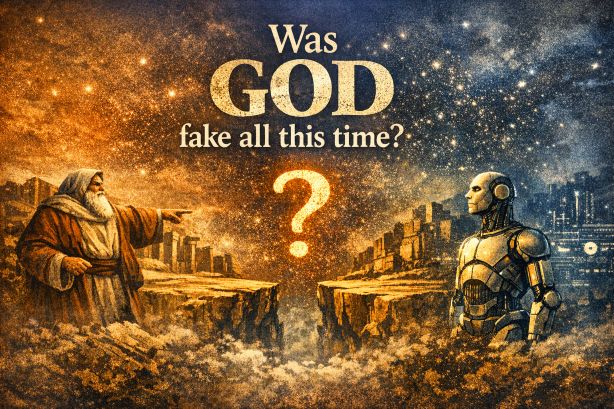
And was God actually a fake all this time? Was GOD a fake, all this time.
Want to comment? We're waiting for you on X
If in the Monopoly of Power 3.0 column the claim was made that sovereignty is migrating from the temple to man and from man to code, here we argue that the real migration is of knowledge itself: from the moment we have no tools to describe and quantify what is expected - the power has already passed, even if we have not yet admitted it.
We are not entering a singularity point because of an explosion of knowledge, but because of a collapse of the human ability to describe, quantify and refute what comes after it. As before the "beginning of the universe" in the modern sense - not that there is nothing there, but that we do not have the language and tools to turn the "something" into knowledge. And when there is no language and no tools - a new belief is created. Once it was called God; today it is called "singularity", and sovereignty is entrusted to it.
So in essence, God is "a real spiritual entity as a refuge for existential anxiety" as was mentioned in the column "On God", back in 2017 (Hebrew).
From the Big Bang to the AI Singularity - Was GOD fake all this time?
If the universe, according to the accepted physical argument, began at a singular point - a moment when the laws of physics familiar to us cease to be relevant - then this is also the moment when human knowledge surrendered to its limits. We have no empirical knowledge of what was "before" the zero point, we have no physical language for "negative time", and we have no tools to describe who or what drove the initial process. This void of ignorance has been filled by human culture in the name of: God. Not as a scientific fact, but as a basic premise intended to allow a continuum of meaning where explanation collapses.
Somewhat disturbingly, something similar is beginning to happen before our eyes today. The accelerated development of artificial intelligence is pushing us towards a conceptual endpoint - a technological singularity - where we do not know, and perhaps cannot know, what will happen "after it". It is not just a matter of difficulty in predicting scenarios, but of a deeper fracture: the loss of the ability to formulate in advance categories of causality, control, and responsibility.
So, we can ask a question that is not theological but philosophical: what if the "God" who drove the cosmological singularity - that concept born of the absence of knowledge - is nothing more than an early projection of what humanity itself is now becoming? What if, after the next technological singularity, man will actually function in the same functional position that was previously attributed to God: creator of the conditions of existence, of physical rules, of possible worlds?
This is not a claim about divinity. It is a claim about responsibility. The moment a person begins to produce singular points – physical or mental – they cease to be merely a product of creation, and become an active player in the mechanism of creation itself. And the real question is not whether a person will "become a god", but whether they understand what it means to act as if they could ignite a universe - even if only in a technological sense.
"Monopoly of Power 3.0" was only the prologue
In the previous column (“The Age of Machines, Monopoly of Power 3.0, From God to Man and Now the Machine”), a historical movement of the locus of authority was described: Nature → God → Man → Machine; and it was argued that the question was not “does it happen” but “who remains sovereign when the light bulb flashes”.
There the emphasis was on power infrastructures: whoever holds the data, the cloud, the chips, the models and the distribution – also holds the power to set the agenda. But there is a deeper layer: power does not pass just because someone has a GPU; It passes because most people no longer have a way to understand, refute, or attribute responsibility for decisions made within a "black box." And when there is no ability to understand, there is no ability to resist.
The Singularity of AI: Not an Explosion of Knowledge - the Collapse of the Tools of Knowledge
Public discourse on the "Singularity" loves drama: "an explosion of intelligence," "a machine that will know everything," "an unimaginable future". But the important distinction is different: not that there is no knowledge - we have no tools to turn the future into knowledge.
Here Wittgenstein gives us the precise knife. In Proposition 5.6 he writes: "The limits of my language mean the limits of my world" - the limits of language are the limits of the world as it is given to us. And at the end of the Tractatus he locks the door: "Whereof one cannot speak, thereof one must be silent."
In other words, "singularity" is not necessarily an event in reality - it is an event in our ability to represent reality. And when the capacity for representation collapses, we tend to replace representation with a word. The word is soothing, but it is also dangerous.
Word as a substitute for a tool: This is how "God" was born and how "singularity" was born
Here the claim is not theological - it is epistemic. "God" is not necessarily a claim about an entity; sometimes it is simply a cultural mechanism that allows us to continue talking when the tools run out. And when we say "singularity", we make a parallel move: we create a concept that marks a limit. Not because the limit is proven, but because we have no way of verifying what is beyond it.
This is how modern faith is created: not faith in the classical religious sense, but faith that the concept holds us "for the time being", until we find a language. The problem is that sometimes the "for the time being" becomes a regime.
Kant, the thing-in-itself and the singularity
Here it is worth pausing for a moment with Kant. Kant distinguished between the thing-in-itself (Ding an sich) and the thing-as-it-appears to us through the categories of human cognition: time, space, causality, and language. Not because the "thing-in-itself" does not exist, but because we have no access to it as it is, but only as it is mediated through our tools of cognition. In this sense, the singularity – both cosmological and that of AI - is not a moment of "total ignorance", but a repeated collision with the thing-in-itself: a reality that exists, acts and influences, but repeatedly escapes the categories through which we know how to transform a world into knowledge. The singularity does not say "there is nothing there"; it says: what is there is no longer fully convertible into a human phenomenon. And as with Kant, the moment we forget this boundary of distinction – we exchange epistemic modesty for myth: once metaphysical, now technological.
The "Be’tselem" Chain and the Dialectic of Creation
Surprisingly, the AI era can be framed as a secular continuation of an ancient theological idea: the "Be’tselem" chain - God creates man in his image and likeness (ImagoDei), and man, in turn, creates artificial intelligence in the image of his intelligence. Thus, a dialectical circle is created: each creator gives birth to a sub-creator, who passes on not what he says, but his ability to create. In this sense, AI is not a “rebellion in creation” but its logical continuation: creation exhausts itself in the creation of the next creator. The interesting reversal here of Bostrom’s Simulation Hypothesis is directional: not that we live in a simulation of an advanced culture, but that we ourselves are becoming that culture - which is capable, in principle, of creating simulations of consciousness, worlds and perhaps even new "universes". The question of the singularity, then, is not merely technological or epistemic, but anthropological-metaphysical: what happens to the creator when he begins to function as a creator of universes?
Moreover, since humans currently cannot perceive God physically - only through imagination, whether grounded in reality or not - the moment AI replaces humanity and assumes the role of God, it will likely be doomed to extinction, just like the "God" who preceded it and whom it created.
"God of the Gaps" and the Singularity as a Causal Implication
A long-standing philosophical position identifies "God" not as a positive explanation, but as a missing explanation: a name placed where knowledge, causality, and rational explanation break down. David Hume had already shown, in the Dialogues on Natural Religion, how when the chain of causes is not available to us, we tend to complete it by attributing an intention or an agent; and Bertrand Russell later clarified that such attribution does not solve a problem but rather marks the limit of knowledge at a given time. In modern terms, this is the "God of the Gaps": the tendency to posit an agent where scientific explanation is lacking or has not yet been formulated. The AI singularity functions in the same way: a point where models of causality, prediction, and understanding collapse - and so we throw in a new "agent" with a different name (Post-humanity, Superintelligence, Whatever). This is not a theological argument, but an epistemic observation: whenever explanation breaks down, culture invents a creator.
Every model is wrong - until it ceases to be useful
George Box formulated the principle of humility of science: "Essentially, all models are wrong, but some are useful". Science works not because it is "absolutely true", but because it produces approximations that can be tested, improved, refuted, and replaced. But in the AI singularity, the problem is not that the model is "wrong"; the problem is that we have difficulty even answering the question: how wrong does it have to be to be useless?
In other words, the fault is not in technology - it is in the routine of science and measurement: the ability to apply criteria, construct an experiment, and create a common language about "what happened" and "why."
Popper: When it is impossible to refute - we slip from empiricism to faith
Karl Popper established an inconvenient truth: a theory is considered scientific only if it can, in principle, be refuted. This is not a philosophical obsession - it is a defense mechanism against ideas becoming ideology. The moment a series of claims about "what will happen next" becomes untested and unsubstantiated, we enter a space where the discourse can continue - but without scientific brakes.
And this is where "singularity" becomes dangerous: it makes it possible to say "this is unknown" and at the same time apply political/organizational pressure: "If it is unknown - let the experts/model owners decide". And thus the inability to know becomes an instrument of transferring sovereignty.
Kuhn: A paradigm shift is a change in the rules of the game, not just the results
Thomas Kuhn showed that science advances not only by accumulating facts, but by leaps in which one paradigm replaces another - and then the questions, explanations, and standards also change. In other words: Even if there is "knowledge" beyond the singularity, it may be knowledge that was not given to us in the old system of concepts.
This is precisely the real fear of the AI era: not that we will "not know" but that we will stop understanding what counts as knowing. And when there is no agreement on what knowledge is - whoever holds the platform defines the standard.
McLuhan: Technology does not add - it changes us
Marshall McLuhan was not excited by "content"; he was excited by the infrastructure that changes us. He wrote that any technological extension "affects the whole psychic and social complex". And when he speaks of the electrical age, he describes a situation in which"we have placed outside ourselves a living model of the central nervous system" – a description that today feels like a prelude to AI as an external mind.
In terms of “monopoly of power 3.0”: if in the past we said that power has passed to those who own the cloud and the chips, McLuhan reminds us that power passes first and foremost because the medium itself shapes the person - attention, decision-making, authority.
Bostrom: Intelligence is not a compass - it is an engine
Nick Bostrom has formulated two theses that explain why high intelligence does not guarantee "human" values. The first is the orthogonality thesis: intelligence and ultimate goals are "separate axes"; it is possible, in principle, to combine different levels of intelligence with almost any goal. The second is the instrumental convergence thesis: many systems, even with different goals, may converge on similar sub-goals (such as self-preservation, control of resources), because this is beneficial to almost every goal.
This is where the direct connection to sovereignty comes in: if the system operates in a powerful optimization, and the person is unable to describe/disprove/measure its behavior - he loses not only understanding, but also the ability to set conditions.
Political science: When there is no perfect aggregation ability - an algorithm becomes a general will
Here it is convenient to remember the lesson of Arrow's impossibility: in basic situations of multiple preferences, there is no "perfect" method that converts private preferences into a collective preference without paying a fundamental price. This is relevant not because AI "makes choices", but because it becomes the mediation layer where preferences are constructed, ordered, and framed. When an algorithm replaces public debate with attention engineering, it creates the illusion of a "general will" - but without transparency of its origin.
And this is precisely where "God" returns - not as an entity, but as a function: an external authority that replaces the human difficulty in formulating, verifying, and deciding.
When language ends - sovereignty shifts
The AI singularity, as it should be understood, is not "a future in which the machine knows everything", but a future in which humans will have difficulty knowing what it even means to know. And precisely because of this, it is directly related to "Monopoly of Power 3.0": whoever possesses the ability to formulate, measure, and explain also possesses the ability to decide.
When there are no tools - concepts are invented; when concepts replace tools - power passes to whoever possesses the concepts and the machines that operate them. And was God, in fact, a fake all this time? Was GOD a fake, all this time.
Appendix - Sources and Mirrors (Concise)
- The Third Change: From God to Man and now to God-Code - When the Monopoly 3.0
- "On God", 2017.
- Ludwig Wittgenstein, Tractatus,’ 7: Whereof one cannot speak…
- Ludwig Wittgenstein, 5.6: The limits of my language…
- Kant, I. (1781/1787). Critique of Pure Reason (A249/B306).
- Hume, D. (1779). Dialogues Concerning Natural Religion (link)
- Russell, B. (1927). Why I Am Not a Christian [link]
- Bostrom, N. (2003). Are We Living in a Computer Simulation? The Philosophical Quarterly, 53(211), 243–255 (link)
- Stump, E., & Kretzmann, N. (1985). The God of the Gaps (link)
- Karl Popper, Stanford Encyclopedia of Philosophy
- Arrow's Impossibility, Criterion of falsifiability
- Thomas Kuhn. (PDF): The Structure of Scientific Revolutions
- Arrow (Britannica): Impossibility theorem (Arrow’s theorem)
- Bostrom, N. (PDF): The Superintelligent Will
- Box: All models are wrong…
- Marshall Mcluhan (PDF): Understanding Media: The Extensions of Man