



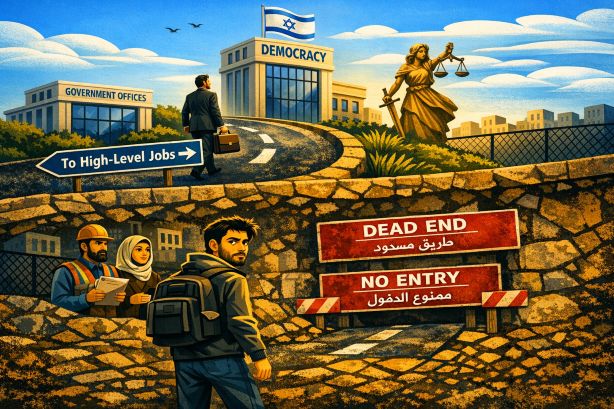

It is precisely out of a deep commitment to Israeli democracy that the time has come to honestly examine the cost of civil inequality.
The debate over civil equality for Arab citizens of Israel does not concern the problem of a particular minority, but rather the core of Israeli democracy itself. Although according to formal law and rules, all citizens of the state are equal before the law, in practice there is an ongoing reality of systematic gaps, in which Arab citizens are perceived and treated as “second-class citizens.” These gaps are expressed in the law enforcement system, in access to centers of governmental power, in economic opportunities, and in the distribution of public resources—and above all, in the institutional internalization of inequality as a natural state. When institutionalized discrimination exists in a liberal democracy, it is not a specific failure but an erosion of the civil principle itself. In this sense, the question of the status of Arab citizens is not a sectoral question, but an ongoing test of Israel's resilience, consistency, and commitment to the values of civil democracy.
Arab civil society in Israel
Arab citizens in Israel are constantly forced to contend with the basic assumption of the various institutions that Arab citizens are less worthy and therefore "deserve" much less than other citizens. This inequality, in a democratic society where everyone is equal before the law and civil rights are anchored in many laws, including basic laws, such as the Basic Law: Human Dignity and Liberty, the Basic Law: Freedom of Occupation, most Arab citizens do not enjoy equality and in fact discrimination against them is already embedded in the establishment. Arab citizens are sentenced to heavier sentences than others for the same offense. They are almost never employed in government institutions and government companies, and they almost never receive grants for the development of startups.
Liberal democracy is fundamentally damaged when civil equality, and I intentionally do not write national equality, does not exist among all citizens of the country. The problem is not just for Arabs but for all citizens. Since when one sector is positioned as "citizens of a different kind," it will be possible to expand discrimination on gender, religious, geographical and economic grounds. In fact, in Israel 2026, this expansion already exists.
How can Israeli democracy be changed from an ethnic democracy to a civil democracy? One of the tools is through the temporary use of the idea of "affirmative action." This model has been applied in advanced countries around the world in the gender context. In the past, they required that every government office or company have adequate representation of women. Once the goal was achieved, they no longer had to implement the "affirmative action" regulations.
There is a vital need to prioritize Arab citizens in admission to government positions of power (except for those who are elected). It is imperative to increase the percentage of Arab citizens employed in government offices in this way until they reflect their number in the population.
One of the consequences of such a move would be increased interest in the needs of Arab society in the areas of employment, education, infrastructure and industry. With implications for the war period: the issue of public mikloth. The example I chose is relevant to today's reality of closing the huge protection gaps between Jewish and Arab society. These gaps expose Arab citizens to the dangers of missiles more than anyone else. We have no public shelters, no protection in areas where there are no fire brigades, there are not enough rescue services that can immediately reach areas hit by missiles. A just society does not abandon hundreds of thousands of people to constant life dangers; such a society ensures that all schools have shelters. As I said, I could choose from examples, but right now this is the most urgent. This is just one example of many, in which the reality is that there are almost no Arab citizens in government offices who would drive positive change processes.
Affirmative action will exist until the long-awaited equality is achieved and about a fifth of Israeli citizens will be able to live in a true democracy.
Equal civil democracy is necessary for the integration of Arab citizens in the country. It is also essential for Israeli democracy as a whole. Democracy is not a tool of one party or one political bloc. A stable, just and strong democracy is a common interest. Through effective and focused advocacy, it is important to unite all lovers of democracy, who in my opinion are an almost absolute majority of elected officials, at the level of Both local and national government. Civil equality does not threaten the essence of Israel as a Jewish state but rather strengthens its democratic nature.
