



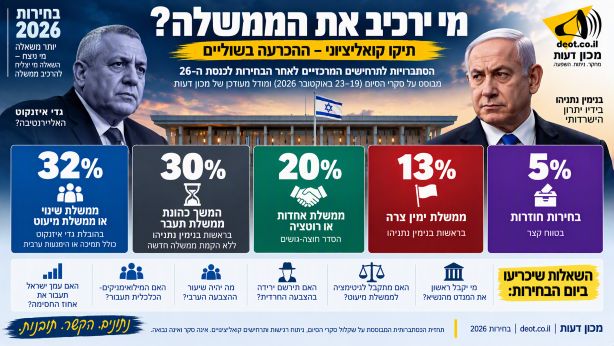

2026 Election Forecast: The opposition holds a numerical advantage (with a 32% probability of forming a minority or majority government). However, in the battle for power, the coalition landscape remains a dead heat, with a 68% probability that Netanyahu will remain in office (whether through a majority, transitional, unity, or minority government). Recent polls reveal a consistent trend: the "Netanyahu bloc" struggles to reach the 61-seat threshold in most predictive models, yet the opposing camp currently lacks a natural Zionist majority to form a government. Consequently, the question is not "Who won the election?" but rather "Who will succeed in preventing their opponent from forming a government?" It is a classic political game of "veto players," where a party with just four seats could prove more significant than one with twenty.
When accounting for the historical tendency of pollsters to underestimate right-wing parties - as well as forecasts from prediction and betting markets - the probability of a "government of change" drops to 28%, while the likelihood of Netanyahu remaining in power rises to 72%.
Key takeaway: The chance of a government not led by Netanyahu is higher than the chance of a narrow right-wing government (32% versus 13%); however, there is no guaranteed path to replacing the current administration. The election is likely to yield a numerical advantage for Netanyahu’s opponents, though not necessarily a viable coalition majority. The likely outcome is a Knesset lacking a natural majority, where the decisive factor shifts from the electoral threshold to the question of Arab support, the veto power of the centrist parties, and the ability of the various sides to reach an arrangement that transcends the political blocs.
Want to comment? We're waiting for you on X
A personal note: I began this series of analyses - grounded in political science and game theory - regarding Israeli politics back in July-August 2025. The analyses predicted that the Netanyahu government would run its full course and that the elections would fail to produce a decisive outcome. This holds true even if the votes of parties representing Arab citizens of Israel are excluded - a scenario suggested by some opposition leaders in their public statements. (Assuming this is merely campaign rhetoric and that subsequent political negotiations will be pragmatic, the opposition holds approximately 70 seats—sufficient to secure a majority and form a government.) Furthermore, this is a qualitative analysis based on quantitative data from various pollsters; consequently, it presents probability ranges rather than a zero-sum forecast. This is particularly relevant given that voter turnout rates among the Arab sector, the Ultra-Orthodox (Haredi) community, immigrants, and expatriates—combined with numerous "veto" conditions - could fundamentally alter the analytical landscape. Accordingly, the extended appendix presents in-depth scenarios, including "edge cases" that could potentially materialize, despite their seemingly low probability.
Who will form the government? Election will be decided less at the ballot box and more in the "twilight zone" of the electoral threshold and during coalition negotiations.
According to the final polls, Israel is not heading toward a clear victory for either political bloc, but rather toward a new strategic stalemate: the camp opposing Benjamin Netanyahu holds a numerical advantage, while the incumbent Prime Minister possesses a built-in survival advantage in the event of a deadlock. The decisive factor is not which party emerges as the largest, but rather the efficiency of the votes cast, the performance of parties hovering near the electoral threshold, and the ability to translate parliamentary seats into a functioning government. While the Deot Institute correctly identified the structural dynamics that will determine the outcome, the final polls necessitate an update to the estimated probabilities and the point of equilibrium between the blocs[1][2].
The current analysis alters the interim conclusion reached by the "Deot" institute on October 13: there is no longer a sufficient basis for the claim that the Right holds an electoral advantage. The latest polling data places Benjamin Netanyahu’s bloc in the range of 50-52 seats, rather than the 52-55 seats assumed in the previous analysis. Nevertheless, incumbent Prime Minister Netanyahu retains an institutional advantage regarding his political survival, as a failure to form an alternative government would leave the transitional government in power. While the previous analysis correctly identified the electoral threshold and "veto players" as the decisive factors, the polling data upon which it relied has become outdated in light of surveys conducted between October 19 and 23.
Key takeaway: These elections are not primarily a contest between Benjamin Netanyahu and Gadi Eizenkot. Rather, they are a contest involving the efficient use of votes, parties hovering near the electoral threshold, "veto players," and the ability to translate an electoral advantage into actual governance.
Final Probabilities
| Scenario | Probability |
|---|---|
| A "government of change" or a minority government led by Gadi Eisenkot | 32% |
| Continuation of a transitional government led by Benjamin Netanyahu | 30% |
| Unity Government / Rotation / Splitting of Blocs | 20% |
| A narrow right-wing government led by Benjamin Netanyahu | 13% |
| Repeat elections, in the short term | 5% |
Assumption of Arab Support (a critical sensitivity variable): The analysis assigns a relatively high probability (32%) to a "government of change" or a minority government; however, it clarifies that this scenario is entirely contingent upon the legitimacy, support, or abstention provided by the Arab parties. Given the political dynamics in Israel, the prospect of center-opposition parties agreeing to rely - whether openly or covertly - on the Arab parties remains a subject of deep controversy; it is possible that the model overestimates the political flexibility of these parties regarding this issue.
A conflict arises between a "survival advantage" and the coalition structure of the right-wing bloc: the model indicates, on one hand, that the Netanyahu bloc centers around approximately 51 seats; yet, on the other hand, it assigns only a 13% probability to a narrow right-wing government and a 30% probability to a transitional government. In practice, if the Netanyahu bloc stabilizes at around 50-52 seats (including the Ultra-Orthodox parties and the Religious Zionism/Otzma Yehudit alliance), the gap to the 61-seat threshold is not substantial. Consequently, the likelihood that the players within the bloc will be able to reach a compromise when put to the test—factoring in parties that might cross the electoral threshold—could well be higher than the conservative estimate presented here.
Probability table, including pollster errors and accounting for prediction/betting markets (Polymarket, Kalshi):
| Scenario | Probability |
|---|---|
| Continuation of a transitional government led by Netanyahu | 35% |
| A "Government of Change" or a Minority Government | 28% |
| Unity Government / Rotation | 23% |
| A narrow right-wing government | 10% |
| Repeat elections | 4% |
See further discussion on the analysis of pollster error[14] and the analysis of prediction markets[21].
Key Probabilities
| Event | Probabilities |
|---|---|
| Netanyahu bloc reaches 61+ | 15% |
| Netanyahu's blocking bloc holds 61+ seats | 85% |
| Amcha Yisrael is crossing the electoral threshold | 35% |
| The Reservists' Party (HaMiluimnikim) crosses the electoral threshold | 47% |
| The two parties hovering near the threshold are making it in | 16% |
| The two threshold-hugging parties fail | 34% |
For the mapping of the scenarios, see the extended academic appendix.
Six Questions That Will Decide the Elections
1. Does Amcha-Yisrael pass the electoral threshold?
Most significant electoral variable in the system.
The movement of a list could effectively shift 3-6 seats between the blocs, bringing the Netanyahu bloc back into contention for the 61-seat threshold[1].
2. Is the "Economic Reservists" passing?
If so, it could become the pivotal player in the next Knesset.
3. What will the voter turnout be in the Arab community?
A few percentage points in turnout could be worth 1–3 parliamentary seats.
4. Does the Haredi protest translate into a decline in voting?
A drop in the number of participating voters could cost the Netanyahu bloc one to two seats.
5. Will a minority government gain legitimacy?
This is likely the most important coalition-related question following the vote count.
6. Who will be the first to receive the mandate from the President?
In a situation of political deadlock, the order of recommendations is a strategic asset.
Bottom line
Likelihood of a government not led by Benjamin Netanyahu is currently higher than the likelihood of a narrow right-wing government. That said, there is not yet a clear, natural majority to replace the current leadership. Therefore, the most plausible scenario involves a numerical advantage for the bloc opposing Netanyahu, accompanied by complex negotiations in which a transitional government, a minority government, or a unity government remain realistic possibilities.
Most likely outlook is a numerical advantage for Benjamin Netanyahu’s opponents - though without a natural Zionist majority, and with no certainty that they will be able to successfully form a government.
The midpoint:
- Netanyahu bloc: 51 seats.
- Zionist opposition: 54 seats.
- Arab parties: 15 seats.
- Key variable: Whether or not two parties cross the electoral threshold.
The most significant electoral variable is the Israeli public. The most significant governing variable is the willingness of centrist parties to accept a government supported from the outside—or one facilitated by the abstention of Arab parties.
Therefore, the situation should not be described as an "advantage for the Right" or a "victory for the Opposition." The precise characterization is: a coalition deadlock, with a numerical advantage for the bloc blocking Netanyahu, and a survival advantage for the incumbent Prime Minister.
Methodological Notes
Forecast Date: October 24, 2026
Data Basis: Ten polls published between October 19 and 23, 2026 - including five polls released on Friday—along with an analysis by the Institute from October 13. The dataset incorporates polling repositories and tools listed on the "Sources" page, data on "swing" (undecided/shifting) voters, and public information regarding electoral lists, the electoral threshold, and statements made by political actors. The Institute’s sources page prioritizes official sources as the foundation, supplemented by research institutes and data providers, while treating aggregators and dashboards as signals that require cross-verification. The analysis combines non-replicable expert judgment with a structured, explicit chain of calculation: Polls → Pollster-specific adjustments and recency weighting → Sectoral turnout → Electoral threshold application → Bader-Ofer seat allocation → Coalition matrix. Furthermore, a uniform 90-day horizon has been established; the "Blue and White" party has been removed from the list of parties near the threshold; and a single, specific probability has been assigned to each scenario - replacing the use of overlapping ranges that do not necessarily sum to 100%.
Read this far? You're done!
The expansion is intended for those interested in in-depth analysis on which the above summary is based and constitutes an academic-scientific expansion of it.
Appendix: Sources and References
Foundational Sources
- Machon De'ot, "Who Will Win the Elections? Likely No One - A Transitional Government Remains the Most Plausible Outcome, with an Advantage for the Right" (characterizing the forecast as a probabilistic-judgmental update and identifying parties hovering near the electoral threshold, as well as the multiplicity of 'veto players,' as the decisive factors), October 13, 2026.
- Machon Deot, "Will the Elections Be Decided by the Electoral Threshold?" (served as a baseline for comparing probability shifts between September and October), September 10, 2026.
- Information Sources – Machon Deot (including polling databases, the "120 Index," "Wandering Votes," Israel Democracy Institute surveys, and results from the Central Elections Committee).
Databases
- Kolot Nodedim, https://kolot-nodedim.netlify.app
- Madad 120, https://madad120.co.il
- Central Elections Committee, https://www.bechirot.gov.il
- The Israel Democracy Institute, https://www.idi.org.il
Survey Databases and Analysis
- ElectionOwl, https://x.com/electionowl
- Skarim.org, https://www.skarim.org
- Israel Election Tracker
- Israeli Election Polls Database
- Polymarket | The World's Largest Prediction Market
- Prime Minister of Israel after the 2026 election? Odds & Predictions
- Little Moise ® on X: "The Netanyahu Bloc and the Pollsters: What History Says About October 27th" / X
Theoretical Background
- George Tsebelis, Veto Players.
- William Riker, The Theory of Political Coalitions.
- Laver & Schofield, Multiparty Government.
- Shapley & Shubik, Power Indices.
- John Banzhaf, Voting Power and Power Indices.
- Bueno de Mesquita et al., The Logic of Political Survival.
- Calibration, accuracy, and domain variation across one million collective forecasts from prediction platforms | PNAS
Please see full "Academic Appendix, In-depth Analysis" on Hebrew version here.
