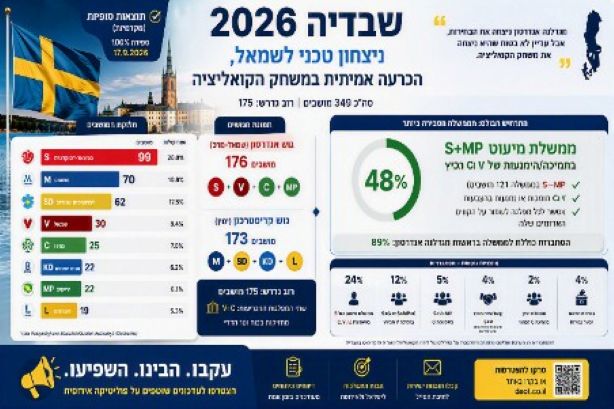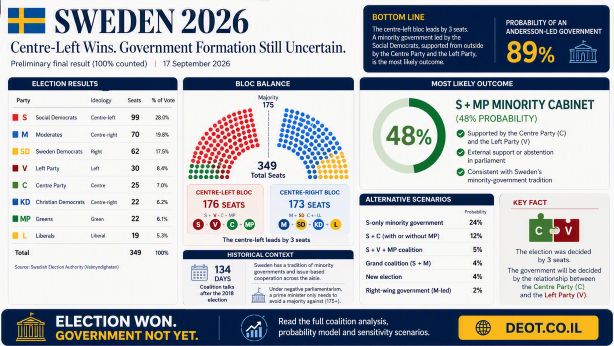



The official results of the Swedish election have been announced: Magdalena Andersson has won, yet it remains uncertain whether she will succeed in forming a coalition.
Her bloc holds 176 seats compared to the opposition's 173; however, the Centre Party (C) and the Left Party (V) maintain conflicting veto positions that could render a parliamentary majority practically unworkable. The resignation of incumbent Prime Minister Ulf Kristersson and the completion of the vote count have shifted the starting point: the central question is no longer which bloc gets the first opportunity to govern, but rather which minority government formula will allow Magdalena Andersson to pass the parliamentary vote without the Centre Party (C) or the Left Party (V) crossing their respective "red lines"[1][2].
Consequently, an S+MP minority government led by Andersson - supported by two separate external arrangements with parties C and V - emerges as the most likely scenario, with a 48% probability. The overall probability of an Andersson-led government stands at 89%. The critical factor is not whether C and V join the cabinet together, but whether both agree to the following formula: refraining from vetoing her investiture in exchange for separate, binding negotiations regarding the budget and the government's policy program.
Israeli readers will likely find parallels between the challenges of coalition formation in Sweden and Israel, as well as food for thought.
The main risk is that V would view remaining outside the government as yet another capitulation to S, while C would regard any detailed agreement with V as effectively a left-wing government. In such a scenario, a government might be formed but fail to pass its first budget.
As of September 18, 2026, the completed count gives the S, V, C, and MP parties a combined 176 out of 349 seats, compared to 173 for the M, SD, KD, and L parties. The result is still subject to formal confirmation, yet Ulf Kristersson has already submitted his resignation, and Magdalena Andersson has invited V, C, and MP to preliminary talks[1][2].
Want to comment? We're waiting for you on X
The situation following the announcement of the results and Kristersson’s resignation:
- The probability of forming a government led by Magdalena Andersson has risen from approximately 80% to 89%.
- The leading scenario is an S+MP minority government, with separate support or abstention agreements from C and V.
- The greatest risk lies not in the initial vote of confidence, but in the first budget, where the conflict between C’s and V’s demands will shift from a potential constitutional crisis to a policy crisis.
- A shift by C to the right-wing camp remains mathematically possible but politically unlikely. Analysts cited by Reuters also assess such a move as unlikely[1].
Probabilities of coalition scenarios (and repeat elections)
Forecast horizon: Until a government is formed or a decision is made to hold snap elections.
Unit of analysis: The composition at the time of the government's swearing-in - not necessarily the arrangement that will remain throughout the entire term.
| Scenario | Government Structure | Possible parliamentary basis | Probability | Change |
|---|---|---|---|---|
| 1 | S+MP, with the support or abstention of V and C | 121 in the government, up to 176 in the voting base. | 48% | +3 |
| 2 | A minority government led solely by S | 99 in the government, with abstentions from MP, C, and V. | 24% | -1 |
| 3 | S+C or S+MP+C, with external V-support. | 124 or 146 in the government | 12% | +2 |
| 4 | S+V+MP, when C is avoided | 151 in the government | 5% | new |
| 5 | S+M center coalition, possibly with C or MP | At least 169 for S+M | 4% | -4 |
| 6 | A right-wing government led by M, with the support of SD, KD, and L. | 173, requiring abstention by the right-wing bloc led by M, with the support of SD, KD, and L. | 2% | -5 |
| 7 | A right-wing government with the SD in the cabinet. | Same bloc of 173 | 1% | -2 |
| 8 | Four candidates rejected and an unusual election | Systemic failure in assembly process | 4% | +2 |
| Total | 100% |
The slight increase in the risk of an unscheduled election stems not from an inconclusive electoral outcome, but from the public conflict between Party C - which refuses to form a government with Party V ministers - and Party V, which demands cabinet representation. If the parliament rejects four nominations for Prime Minister, a new election is required[1][5].
Methodological note: The probabilities represent an analyst's assessment based on coalition theory (Riker), veto players, Shapley-Shubik, and Swedish precedents from the last decade. They do not constitute an official statistical forecast but rather a qualitative-quantitative estimate[7].
The real risk: not the inauguration, but the budget
A distinction must be made between two probabilities:
| Test | Probability |
|---|---|
| Magdalena Andersson passes the vote for Prime Minister. | 89% |
| Her government is passing its first agreed-upon budget. | 72% |
| Government survives 12 months without a crisis of confidence or a budget crisis. | 65% |
| Government is completing its term with its original composition. | 38% |
The gap stems from the fact that abstention suffices for the government's investiture, whereas passing a budget requires a more actively supportive coalition. Party C is expected to demand fiscal discipline, business incentives, and market reforms. Party V is expected to demand welfare spending, worker protections, and a scaling back of market reforms. This is not merely a symbolic dispute over cabinet seats, but a genuine conflict over the distribution of resources.
An S+M government is not impossible
The unusual yet important scenario to watch is that S and M reach a limited understanding regarding "national responsibility" - particularly concerning security, NATO, Ukraine, energy, and crime. Together, S and M hold 169 seats; therefore, the abstention of just one additional party is all that is required to secure the passage of a candidate for Prime Minister.
The probability is low - only 4% - because such a move would undermine M’s opposition identity, diminish C’s bargaining power, and allow SD to position itself as the sole right-wing opposition. However, if C and V exercise an absolute mutual veto, the cost of a broad coalition might be lower than the cost of a snap election.
Tell tale signs worth monitoring
- Does V change its phrasing from a "demand for participation in the government" to a "demand for real influence"?
- Does C publicly distinguish between a government that includes V and a government merely supported by V?
- Is MP invited to full coalition negotiations or only to coordination talks?
- Does S publish a budget framework before Magdalena Andersson’s candidacy is presented?
- Does the Speaker of Parliament grant Andersson the first mandate immediately after consulting with the parties?
- Does M begin speaking of "national responsibility"—a phrase that might signal the opening of a channel to a centrist bloc?
Read this far? You're done!
The expansion is intended for those interested in in-depth analysis on which the above summary is based and constitutes an academic-scientific expansion of it.
Sensitivity Analysis and Academic Methodological Extension
Key variables
The model is particularly sensitive to five variables:
- V’s level of flexibility regarding government portfolios
- C’s level of flexibility regarding parliamentary dependence on V
- Whether MP prefers to join the cabinet or remain outside
- Whether the 176:173 result holds firm following formal approval
- S’s ability to construct a two-track budget agreement with C and V
The party distribution upon which the model relies is: S with 99 seats, M with 70, SD with 62, V with 30, C with 25, KD and MP with 22 each, and L with 19[3].
Core Sensitivity Matrix: C and V Behavior
The figures in the table represent overall probability of forming a government led by Magdalena Andersson, without predetermining its exact composition.
| V insists on joining the cabinet | V open to an agreement for external support | V settles for abstention | |
|---|---|---|---|
| C refuses any dependence on V | 42% | 68% | 76% |
| C agrees to parallel external support | 72% | 94% | 96% |
| C agrees to an inclusive government V | 95% | 97% | 98% |
Matrix Analysis
- Most sensitive cell is the top-left one: if V demands cabinet posts and C refuses not only to sit with V but also to allow a government dependent on it, the "176" coalition foundation collapses operationally.
- Most likely scenario at present is the central cell: C does not sit with V, yet both parties separately enable an S or S+MP government. This forms the basis for the 48% probability assigned to the leading scenario.
- Even if V does not immediately drop its demand for cabinet posts, it could abstain in the initial vote while continuing negotiations regarding the budget, committees, legislation, and reforms. Therefore, a public demand for ministerial portfolios is not automatically tantamount to voting against the government.
Stress tests
| Shock | Impact on the leading scenario S+MP | Updated probability of an Anderson government | Meaning |
|---|---|---|---|
| Baseline scenario | 48% | 89% | Tough but solvable negotiations |
| V expressly waives cases | 14+ Points | 96% | Almost eliminates the contradiction with C |
| C agrees to a parallel support model with V | 10+ Points | 95% | Allows for a separate policy agreement with each party |
| C refuses any government that depends on V's votes | 23- Points | 64% | Requires S+C, S+M, or a crisis |
| V votes against any cabinet of which she is not a member | 2-7 Points | 58% | Significantly increases the risk of elections |
| MP remains outside the government | Points -8 for S+MP scenario | 87% | Most of the probability shifts to the S-government alone |
| A shift of one seat, 175–174 to the left | 2- Points | 87% | A minimal majority, yet still sufficient |
| A two-seat shift, 174:175 to the Right | 32- Points | 55% | Initiative returning to the right-wing bloc, but C remains key player |
| Prior agreement on a budget framework | 7+ Points | 95% | Reduces risk of government collapsing after the swearing-in |
| Deadlock lasting more than three rounds of nominations | 2-5 Points | 60% | Unusual elections are turning into a real threat |
Methodological note: Changes do not accumulate linearly. For example, V’s relinquishing of portfolios and C’s agreement to provide external support overlap significantly; therefore, the 14 and 10 points should not simply be added together.
Why is S+MP the baseline scenario?
1. Negative parliamentarism
In Sweden, a candidate for Prime Minister is not required to secure 175 votes in favor; the candidate fails only if at least 175 Members of Parliament vote against. Therefore, an abstention by the C or V parties can be just as significant as a vote of support for the purpose of investiture, even if it does not necessarily ensure stability regarding the budget and legislation[5].
2. Separating Cabinet participation from parliamentary support
An S+MP government allows:
- C to say it is not sitting with V.
- V to say it did not grant C exclusive control over the government.
- S to retain the premiership and control over the agenda.
- MP to secure an organizational achievement and climate policy, without making the government too broad.
Weakness is that either of the two external supporters can become a veto player regarding the budget.
3. The incumbent Prime Minister's exit from the initial phase of the game.
Ulf Kristersson's resignation reduces the likelihood of a symmetrical contest between two candidates. The Speaker of the Parliament will now manage the nomination process, while the Social Democratic camp holds both a seat advantage and the political initiative[1][2].
Footnotes and sources
[1] ;Sweden's prime minister steps down after losing election | Reuters.
[2] Sweden’s PM resigns after centre-left bloc wins slim majority in election | Sweden | The Guardian.
[3] Sweden General election 2026 (Riksdag) - Results | ElectioMap.
[4] Sweden’s centre-left edges ahead by three seat in preliminary results | Euronews.
[5] News Analysis: Sweden's center-left edges ahead, but path to power remains uncertain | The Star.
[6] Election results 2026 - Riksdag, regional and municipal elections | Swedish election authority.
[7] רקע תיאורטי אקדמי - תיאוריות, מדדים ואלגוריתמים בניתוח התנהגות מתורת המשחקים ומדע המדינה